Paint Booth Specifications: The Technical Checklist to Run Before You Sign the Purchase Order
Most paint booth purchases in India go wrong at the quotation stage, not the installation stage.
A plant head asks three suppliers for a price on “a 6m x 4m paint booth”. Three quotes come back. One is 40% cheaper. It gets approved. Eight months later the booth is producing dust nibs on every third component, the exhaust motor is drawing more current than the panel was rated for, and nobody can explain why the finish quality drops every afternoon.
Nothing failed. The booth was simply never specified. It was only sized.
This guide covers what actually belongs in a paint booth specification, what numbers to ask for in writing, and what to test before you accept handover. It is written for the person who has to sign off on the capital expenditure and then live with the equipment.
Quick answer: what defines a paint booth specification?
A complete industrial paint booth specification defines eight things: airflow pattern and air velocity, total air volume (CFM), filtration stages with filter grades, booth pressure balance, illumination level in lux, structural material and panel construction, electrical load with motor rating, and the exhaust discharge arrangement. A quotation that only states booth dimensions and a fan HP rating is not a specification.
1. Airflow pattern: decide this before anything else
Every other number in the specification follows from this one choice.
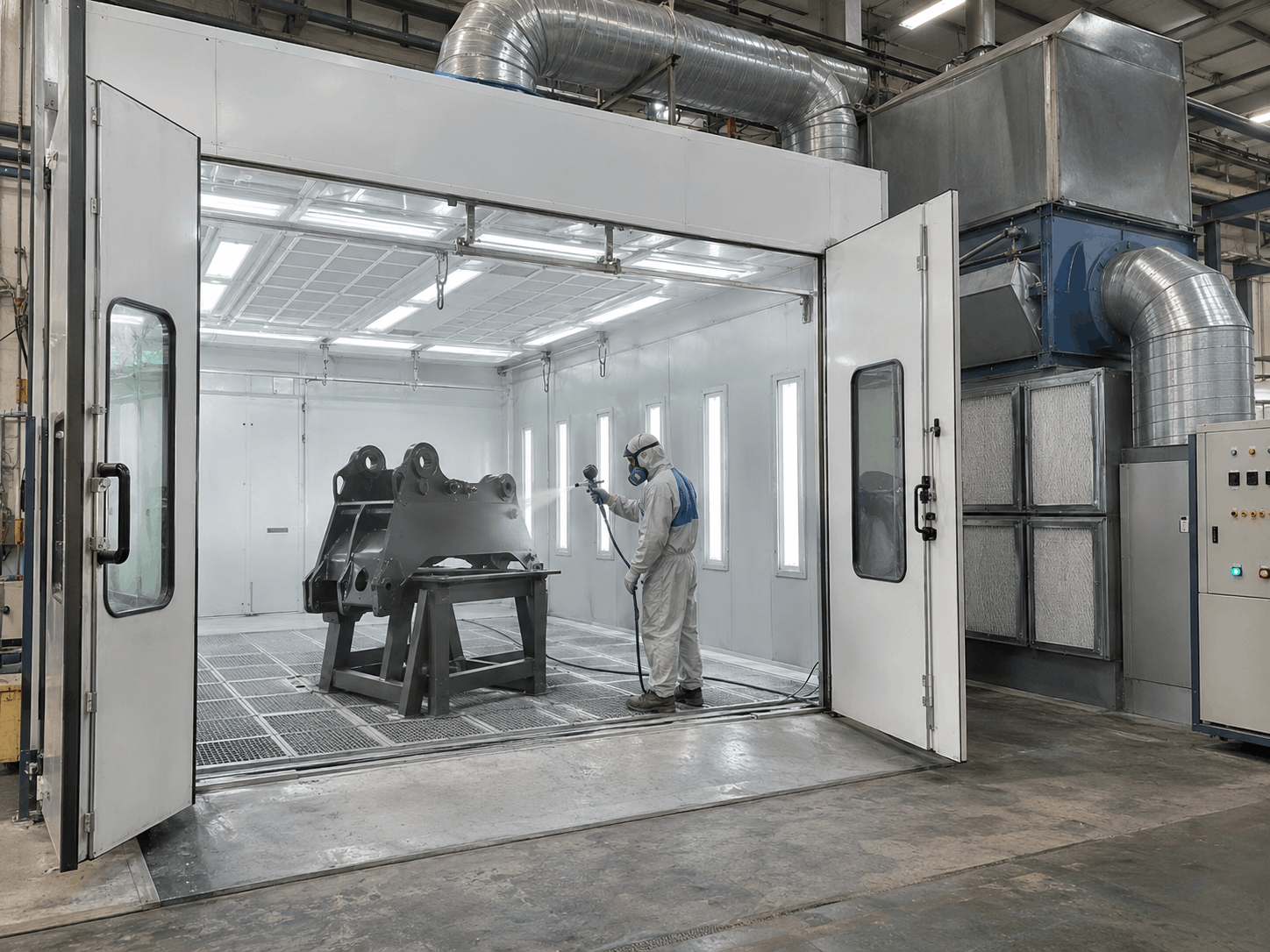
Cross-draft. Air enters at one end and exits at the other, moving horizontally past the component. Cheapest to build, cheapest to install, no floor pit required. The trade-off is that air passes over the wet surface after it has already picked up overspray from the front of the part. Fine for structural fabrication, machinery housings, and industrial equipment where the finish needs to be even and protective rather than cosmetically perfect.
Semi-downdraft. Air enters through the ceiling at the front half of the booth and exhausts at floor level towards the rear. A genuine middle option. Better contamination control than cross-draft, without the civil work a full downdraft needs.
Full downdraft. Air enters through a filtered ceiling plenum across the whole booth and is drawn down through a floor grating into an under-floor pit or exhaust plenum. Overspray moves away from the operator’s breathing zone and away from the painted surface. This is what automotive body and high-value component finishing needs, and it is the most expensive option because of the pit excavation.
Side-draft. Ceiling supply, extraction through side walls at low level. A workable alternative when your floor cannot be excavated. Slightly less uniform than full downdraft, considerably better than cross-draft.
The decision driver is not budget. It is your rejection cost. If a single rework cycle on your component costs more than a few hundred rupees in labour, material, and delay, the downdraft premium pays for itself faster than the finance team expects.
2. Air velocity and volume: the two numbers most quotations skip
Air velocity is the speed of air moving through the booth’s cross-section, measured in metres per second or feet per minute. It is the single best predictor of whether your booth will actually work.
Figures widely specified in industrial practice, and referenced in NFPA 33 (Standard for Spray Application Using Flammable or Combustible Materials):
| Booth type | Typical design air velocity |
|---|---|
| Cross-draft | ~0.5 m/s (100 fpm) through the booth cross-section |
| Downdraft / side-draft | ~0.25–0.3 m/s (50–60 fpm) downward through the working zone |
| Open-face / bench booth | ~0.5 m/s (100 fpm) at the face opening |
Confirm the exact requirement against the current edition of NFPA 33 and your own state pollution control board’s consent conditions, since both are revised periodically and local requirements differ.
From velocity you get volume. Multiply the cross-sectional area the air passes through by the design velocity.
Worked example. A cross-draft booth 4 m wide and 3 m high has a cross-section of 12 m². At 0.5 m/s, required volume is 6 m³/s, which is roughly 21,600 m³/hr or about 12,700 CFM. Now ask the supplier which fan model delivers 12,700 CFM against the static pressure of your filter stack and duct run, not in free air. Free-air fan ratings are the most common source of underperforming booths in the field.
What to write into the purchase order: design air velocity, total air volume in CFM or m³/hr, fan model and curve, and the total system static pressure the fan was selected against. If a supplier cannot produce a fan curve, they have not done the calculation.
3. Filtration: ask for grades, not adjectives
“Multi-stage filtration” and “advanced filtration” tell you nothing. Filter grades do. A standard three-stage wet-paint arrangement looks like this:
Stage 1 — Intake pre-filter. Coarse dust from ambient air. Typically G4 / ISO Coarse class. Cheap, replaced often.
Stage 2 — Ceiling or plenum filter. The filter that determines your finish quality, because it is the last thing the air passes through before reaching the component. Commonly F5 to F9 class (ISO 16890 ePM ratings under the current standard). This is where cheap booths cut corners.
Stage 3 — Paint arrestor / exhaust filter. Fibreglass or concertina paper media that captures overspray before air reaches the fan and the stack. Protects the motor and keeps your emissions within consent limits.
For powder coating, the arrangement changes completely: cartridge filters with reverse-pulse cleaning and powder reclaim, not disposable media. For high-volume wet spraying, a water-curtain (water wash) booth traps overspray in recirculated water instead of filter media, which lowers consumable cost but adds sludge handling and water treatment obligations.
Three questions worth asking any supplier:
- What is the filter changeout interval at my expected duty cycle?
- What does a full set of replacement media cost, and are the sizes standard or proprietary?
- Is there a differential pressure gauge or manometer across the filter bank so my operator knows when to change them?
That third point matters more than it sounds. Filters are almost always changed too late, and a clogged bank quietly strangles airflow until the finish degrades. A ₹3,000 manometer prevents a recurring quality problem.
4. Pressure balance
A paint booth should run at slight positive pressure relative to the surrounding shop, so ambient dust is pushed out rather than drawn in. Supply volume is set marginally higher than exhaust volume to achieve this.
A blast booth or a shot blasting enclosure is the opposite case: it runs at negative pressure to keep abrasive dust contained. If a supplier proposes the same fan arrangement for both, that is a real signal about their engineering depth.
Specify the intended pressure differential and ask how supply and exhaust will be balanced during commissioning.
5. Illumination: 800–1,000 lux at the work surface
Operators cannot correct what they cannot see. Runs, sags, dry spray, and thin coverage are all visible defects during application, provided the light is adequate and colour-correct.
- Target 800–1,000 lux measured at the component surface, not at the ceiling
- Light fittings must be paint-booth rated and suitable for a flammable-vapour area, sealed from the booth interior and serviceable from outside
- Use consistent colour temperature (typically 5,000–6,500 K) so shade assessment is repeatable
- Position fixtures on the side walls at working height as well as overhead; overhead-only lighting leaves vertical surfaces in shadow
6. Structure, material, and the things buyers forget
- Panel construction: wall thickness and whether panels are single-skin or insulated sandwich. Insulated panels are required if you intend to add a bake or flash-off cycle later.
- Material of construction: galvanised steel or pre-coated sheet for the shell, with corrosion-resistant treatment on any surface exposed to solvent and moisture.
- Floor grating: load rating in kg/m², and clearly stated whether it carries a trolley or a forklift.
- Doors: clear opening size checked against your largest component on its fixture, not the bare part. Personnel door with an outward-opening, push-bar exit.
- Exhaust stack: discharge height and location per your pollution control board consent, kept clear of fresh-air intakes on your own or neighbouring buildings.
- Electrical: connected load, motor kW and frame, starter type, and whether a VFD is included. A VFD is worth specifying if your booth runs partial shifts, because it lets you drop airflow during idle periods instead of running full volume all day.
7. Compliance obligations in India
Compliance is the buyer’s responsibility, not the manufacturer’s, and it is best sorted before the equipment arrives.
- Factories Act, 1948 — provisions covering ventilation, removal of dust and fume, and precautions against dangerous fumes and flammable substances apply directly to spray painting operations.
- State Pollution Control Board consent — Consent to Establish and Consent to Operate, with conditions typically covering stack height, VOC emissions, and disposal of paint sludge and used filter media.
- Hazardous waste rules — paint sludge, contaminated filters, and solvent residue are regulated waste streams requiring authorised disposal.
- NFPA 33 / fire safety — airflow and interlock practice, electrical classification of the spray zone, and fire suppression where required by your insurer or local authority.
Ask your supplier for the documentation you will need at inspection: airflow test report, electrical schematic, layout drawing with stack details, and equipment datasheets. Reputable Paint Booth Manufacturers in India hand these over as standard rather than assembling them after a notice arrives.
8. Commissioning acceptance tests: what to verify before you release final payment
Structure your contract so a defined portion of payment releases only after these pass:
- Airflow traverse. Anemometer readings at multiple grid points across the working section. Compare measured average against the specified design velocity. Check uniformity too, not just the average, because a booth can hit its average while having a dead zone in one corner.
- Pressure differential. Verify slight positive pressure with clean filters installed.
- Motor current. Measured amperage against nameplate rating with the full filter stack in place.
- Illumination. Lux meter readings at the component surface at several positions.
- Smoke or tracer test. A visual check that air moves the way the drawing claims, with no recirculation or turbulence around the operator position.
- Noise level. Measured at the operator position, in dB(A).
- Trial panel. A real component, painted by your own operator, inspected under booth lighting. This is the test that matters.
Record every reading in a signed commissioning report and keep it. It becomes your baseline, and two years later it is how you prove that performance has drifted.
9. Where the money actually goes
Purchase price is a fraction of what a booth costs you over its life. Four ongoing items usually outweigh the difference between two competing quotes:
Electricity. Fan motors run every production hour. A 15 kW exhaust motor running 8 hours a day, 300 days a year, at ₹8 per unit works out to roughly ₹2.9 lakh annually. A more efficient fan selection or a VFD changes that number meaningfully.
Filter media. Recurring, and proprietary-sized filters cost more than standard ones for the life of the booth.
Rework. The quietest cost and usually the largest. Every rejected component consumes paint, labour, oven time, and schedule.
Downtime. A booth built so that filter changes require dismantling panels will be maintained late, which loops straight back into rework.
A slightly higher quotation with a better fan curve, standard filter sizes, and accessible service points is frequently the cheaper booth by year two.
10. Five specification mistakes worth avoiding
- Sizing the booth to the part instead of the fixture and the operator. You need working clearance around the component, not just clearance for the component.
- Ignoring make-up air. Extracting 12,000 CFM from a shop means 12,000 CFM has to enter from somewhere. Without a designed supply path, the booth starves and pulls dirty air through door gaps.
- No provision for flash-off or bake. Retrofitting heating into an uninsulated single-skin booth is expensive. Decide now, even if you install later.
- Accepting free-air fan ratings. Always ask for performance against actual system static pressure.
- Leaving commissioning undefined. If the contract does not say what “working” means in measurable terms, you have no basis to reject a booth that underperforms.
Frequently asked questions
What air velocity should an industrial paint booth maintain? Industrial practice and NFPA 33 reference roughly 0.5 m/s (100 fpm) for cross-draft and open-face booths and roughly 0.25–0.3 m/s (50–60 fpm) downward for downdraft booths, measured in the working zone. Verify against the current standard edition and your state pollution control board consent conditions.
How do I calculate the CFM requirement for my paint booth? Multiply the cross-sectional area that air passes through (in square metres) by the design air velocity (metres per second) to get volume in m³/s, then convert. Select the fan against total system static pressure including filters and ductwork, never against free-air ratings.
Which filter grades belong in a wet paint booth? A common three-stage arrangement uses a G4-class intake pre-filter, an F5–F9 class ceiling or plenum filter, and fibreglass or paper paint arrestors on the exhaust side. Powder coating uses reverse-pulse cartridge filters with reclaim instead.
Should a paint booth run at positive or negative pressure? Positive. Slight positive pressure keeps ambient dust out of the coating environment. Blast booths and abrasive enclosures run negative pressure instead, to contain dust.
What lighting level does a paint booth need? Target 800–1,000 lux at the component surface, using booth-rated sealed fixtures at a consistent colour temperature, with side-wall lighting at working height in addition to overhead fittings.
What should I test before accepting handover of a new paint booth? Airflow traverse against design velocity, pressure differential with clean filters, motor current draw, lux readings at the work surface, a smoke or tracer airflow test, noise at the operator position, and a trial panel painted by your own operator. Record all readings in a signed commissioning report.
What is the difference between a water curtain and a dry back paint booth? A water curtain booth captures overspray in continuously recirculated water, which suits high-volume spraying but adds sludge and water handling. A dry back booth uses replaceable filter media, which is simpler to install and maintain at lower volumes.
Specify first, then get quotes
The pattern is consistent across plants: buyers who write a specification and then invite quotations get comparable numbers and a booth that performs. Buyers who invite quotations and let each supplier define the scope get three incomparable documents and a decision made on price alone.
Write down your airflow pattern, design velocity, volume, filter grades, lux target, panel construction, electrical load, and commissioning acceptance criteria. Issue the same document to every supplier. The quotations that come back will tell you a great deal about who has engineered a solution and who has priced a box.
Egeiro Prism Engineering designs and fabricates industrial paint booths in-house at Coimbatore, covering the structural shell, ventilation, filtration package, installation, and commissioning. If you are preparing a specification for your facility, our engineering team can review your component sizes, production volume, coating process, and floor layout, then recommend an airflow configuration and filtration package that fits how your line actually runs.
Explore our full range of industrial paint booth systems, or read more about our approach as Paint Booth Manufacturers in India.
Egeiro Prism Engineering Pvt. Limited 169/1D, Madukkarai Main Road, SIDCO Industrial Estate, Coimbatore – 641021, Tamil Nadu, India Phone / WhatsApp: +91 8925597007 Email: egeiro@prismege.com