Shot Blast Machine Spares: Why the Right Parts Make or Break Your Production Line
If you have ever run a shot blasting operation, you already know this feeling — the machine slows down, surface finish becomes inconsistent, and then you discover the wheel blades have worn out again. Downtime in a production environment is not just frustrating; it is expensive. Every hour your shot blast machine sits idle, orders pile up and costs climb.
The real culprit, more often than not, is not the machine itself. It is the quality of the spare parts running inside it.
At Egeiro Prism Engineering Pvt. Ltd., based in Coimbatore’s SIDCO Industrial Estate, we have spent years understanding exactly what makes shot blast machine spares fail — and more importantly, what makes them last. In this guide, we break down the critical spares inside every shot blasting machine, what to look for when choosing them, and how the right supplier can transform your maintenance costs.
What Are Shot Blast Machine Spares and Why Do They Wear Out So Fast?
A shot blast machine works by projecting steel shots or grit at extremely high velocity onto metal surfaces to clean, deburr, or prepare them for coating. The components at the heart of this process — the blast wheel assembly — are constantly under attack from the very abrasive media they are throwing.
Think about it: a blast wheel can rotate at over 3,000 RPM while hurling hardened steel shots at speeds of 70–80 metres per second. Under these conditions, even the toughest materials wear out eventually. The question is — how fast?
The answer depends almost entirely on:
- Material quality — High-chrome alloy parts last significantly longer than standard cast iron or low-quality steel
- Manufacturing precision — Poorly balanced wheels or blades cause uneven wear and premature failure
- Compatibility — Generic parts that do not precisely match your machine’s specifications perform inconsistently
This is why sourcing shot blast machine spares from a specialist manufacturer — rather than a generic distributor — makes such a measurable difference on the shop floor.
The Key Components You Should Never Compromise On
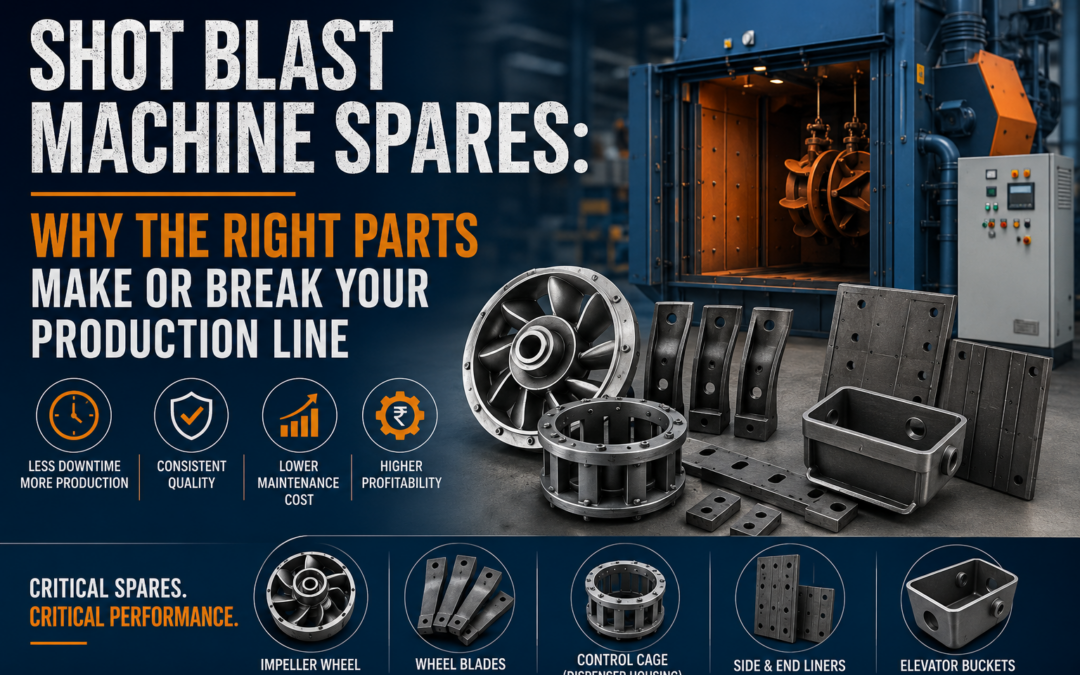
1. Impeller Wheel
The impeller wheel (also called the distributor) sits at the centre of the blast wheel assembly and feeds abrasive media outward to the blades through centrifugal force. Because it is in direct contact with the shot stream at all times, it faces relentless abrasive wear.
Low-quality impellers lose their shape quickly, disrupting the shot flow and creating an uneven blast pattern. This directly degrades your surface finish quality. High-chrome alloy impeller wheels, like those manufactured by Egeiro Prism Engineering, maintain their geometry far longer — translating to a consistent, predictable blast pattern throughout their service life.
2. Wheel Blades
If the impeller is the heart of the wheel assembly, the wheel blades are its muscle. They are responsible for propelling the abrasive at the velocity needed for effective surface preparation.
Blade wear is the most common cause of reduced machine performance. As blades wear thin, shot velocity drops, surface cleanliness profiles fall short, and your downstream painting or coating adhesion suffers. A full set of worn blades can reduce cleaning efficiency by 30–40% before most operators even notice.
For demanding applications, blades manufactured from high-chrome steel with hardness ratings of 60–65 HRC offer significantly extended service intervals compared to standard alternatives.
3. Control Cage (Dispenser Housing)
The control cage determines exactly where the abrasive is directed — it is what makes the blast pattern accurate and repeatable. A worn or imprecise control cage results in abrasive being thrown outside the intended blast zone, hitting liners and internal walls instead of the workpiece.
This causes two problems at once: poor surface treatment results and accelerated wear on your cabinet liners. Replacing the control cage at the right interval — before it degrades your process — is a fundamental part of good maintenance practice.
4. Side Liners and End Liners
Liners are your machine’s internal armour. They protect the blast cabinet walls from the constant bombardment of rebounding shot and ricocheting abrasive. Without properly fitted, wear-resistant liners, you are essentially allowing your machine to destroy itself from the inside out.
Side liners and end liners made from manganese steel or high-chrome alloy provide the hardness and toughness needed to absorb this punishment. When liners are allowed to wear through entirely, the structural cabinet walls are exposed — and cabinet repairs are far more costly than liner replacements.
5. Elevator Buckets
Once shot media has done its job and falls to the machine’s collection hopper, elevator buckets carry it back up for recirculation. These parts might seem less critical, but worn or cracked elevator buckets reduce media recovery efficiency, leading to increased shot consumption and higher operating costs.
Robust, well-fitted elevator buckets keep your abrasive recirculation loop running smoothly — a small component that has an outsized impact on overall machine economy.
The High-Chrome Advantage: Why Material Choice Is Everything
One question we hear from engineers and plant managers regularly is: “Are the more expensive high-chrome parts actually worth it?”
The short answer is yes — almost always.
Standard cast parts may cost less upfront, but they wear out faster. When you factor in the labour cost of frequent changeouts, unplanned downtime, and the effect of degraded performance on your product quality, the total cost of ownership for cheaper parts is almost always higher.
High-chrome alloy spares — particularly those with chromium content in the 26–28% range — deliver:
- Greater hardness and abrasion resistance, extending service intervals
- Dimensional stability, so blast patterns remain consistent throughout the part’s life
- Better impact resistance, reducing the risk of sudden failure mid-production
At Egeiro Prism Engineering, our wear-resistant spares are engineered with these principles at their core. We use in-house machining and testing to ensure every part meets tight dimensional tolerances before it leaves our facility in Coimbatore.
Compatible With All Major Turbine Brands
One of the most common challenges plant managers face is sourcing spares for machines from brands that have long delivery timelines, charge premium OEM prices, or have regional supply issues.
Egeiro Prism Engineering designs and manufactures shot blast machine spares that are compatible with all major turbine brands. Whether your shop floor runs older machines or newer automated blast systems, our engineering team can identify the right replacement components for your specific setup — and deliver them quickly.
We maintain a ready inventory of fast-moving spares so your machine does not sit idle while you wait weeks for a part to arrive from overseas.
How to Know When It’s Time to Replace Your Blast Wheel Spares
Experienced maintenance teams often develop a feel for their machines. But relying on instinct alone can mean you are reacting to failures rather than preventing them. Here are clear, practical indicators that your shot blast machine spares need attention:
- Uneven surface finish on workpieces, indicating inconsistent shot velocity or blast pattern
- Increased vibration or noise from the blast wheel assembly, which often signals blade or impeller imbalance
- Rising shot consumption without a corresponding increase in workload — worn components recirculate media inefficiently
- Visual inspection reveals blade thickness below 8–10 mm — at this point, replacement should be scheduled immediately
- Blast pattern has shifted from its original position, indicating a worn or misaligned control cage
Planned maintenance intervals, supported by scheduled spare part replacements, consistently outperform reactive maintenance both in cost and in production reliability.
Why Plant Managers Across India and the UAE Trust Egeiro Prism Engineering
Located at 169/1D, Madukkarai Main Road, SIDCO Industrial Estate, Coimbatore, Egeiro Prism Engineering serves customers across India and the UAE with a commitment to quality, speed, and genuine technical support.
Here is what our customers consistently tell us makes the difference:
- Engineering Expertise — Our team does not just supply parts; we help you select the right ones. We analyse your current wear patterns, advise on material upgrades, and recommend optimal change intervals for your specific application.
- In-House Manufacturing — Every component we supply is manufactured and quality-checked at our own facility. This means tighter control over material specifications, dimensional accuracy, and delivery timelines.
- Fast Turnaround — We maintain a working inventory of critical spares. For most standard components — wheel blades, impeller wheels, liners, control cages, elevator buckets — we can fulfil orders quickly without lengthy lead times.
- After-Sales Support — When you buy from Egeiro Prism Engineering, our relationship does not end at delivery. We offer technical support for installation, performance troubleshooting, and maintenance planning.
Serving Industries That Cannot Afford Downtime
Shot blasting is not limited to one sector. Our spares support operations across:
- Automotive component manufacturers — where consistent surface profiles are critical for paint adhesion
- Foundries and castings — for cleaning and de-sanding cast metal parts at high volume
- Steel fabrication and structural work — for rust removal and surface preparation before coating
- Aerospace and defence manufacturing — where surface finish specifications are strict and non-negotiable
- General engineering and CNC machined components — requiring precise surface conditions before further processing
Wherever abrasive blasting is used, the quality of the spares inside the machine directly determines the quality of the output.